




What's New with GPT-5 (Launched August 7, 2025)
- Unified + Smarter Architecture GPT‑5 replaces previous models like GPT‑4, GPT‑4o, GPT‑4.5, GPT‑4.1, and the O-series. It's now the flagship, default model across ChatGPT and available via API.
- Multi‑Mode System with Dynamic Routing. It features a system of fast, high-throughput models and "thinking" models, with a real-time router choosing the appropriate mode based on task complexity and tool needs.
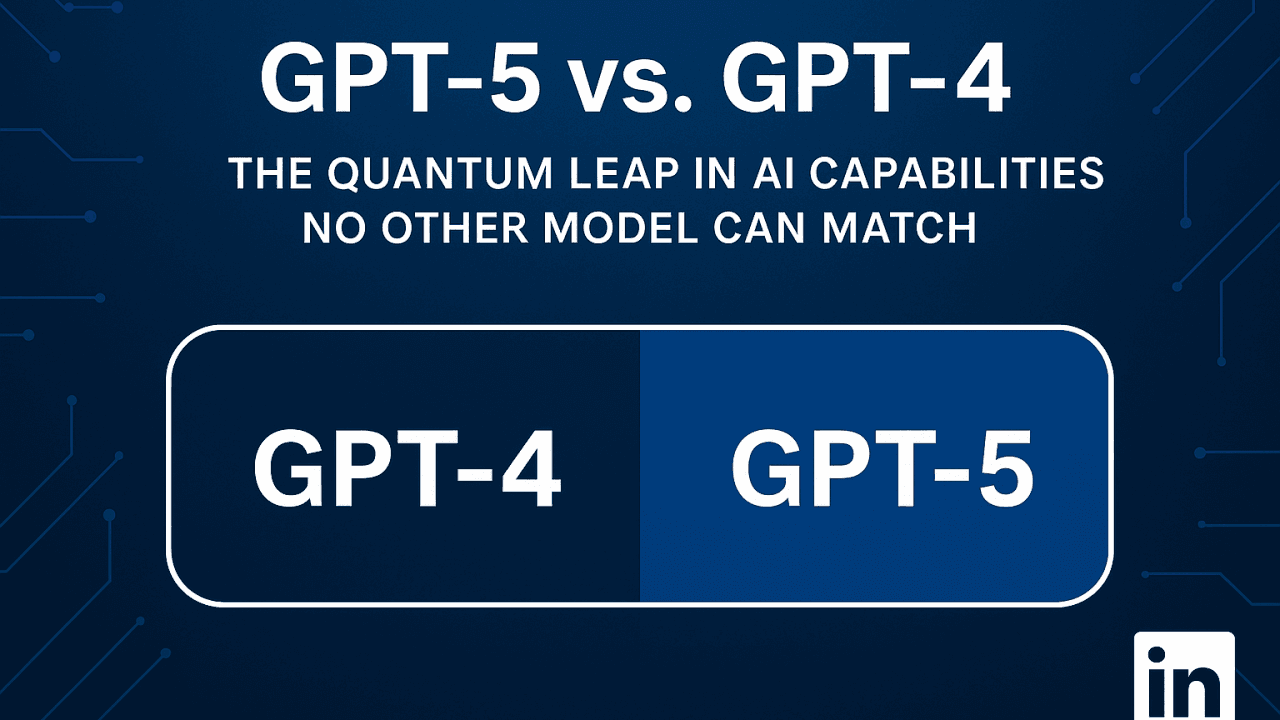
Performance & Capabilities: GPT-5 vs. GPT-4
- Coding & Agentic Tasks
- Reasoning & Factuality
- Contextual Understanding & Length
- Multimodal Proficiency
Additional Highlights
- Greater Safety & Collaboration GPT‑5 reduce hallucinations, more transparently acknowledges its limitations, and behaves more like a thoughtful collaborator.
- Customization for Developers: Features like verbosity (choose response length) and reasoning_effort (minimize computation for speed) allow developers fine-grained control. It also supports "custom tools" and dialogues with preambles, progress updates, and improved error handling during tool use with OpenAI.
- Enterprise & Integration Ready Microsoft is integrating GPT‑5 across Copilot and VS Code, enabling code writing, testing, deploying, and agent development in-editor.
- Varied Pricing Tiers Released in three API versions—standard, mini, and nano—tailored to balance performance, latency, and cost. Within ChatGPT, there's also a Pro version optimized for parallel thinking, computing.
Why GPT-5 Stands Out
- Superior Coding, Reasoning, and Language Understanding: Delivers a breakthrough in precision, flexibility, and reliability in domains like code generation, problem-solving, and complex task execution.
- Unprecedented Context Handling: With colossal context windows, it can manage exceptionally long-form conversations, documents, and workflows.
- More Reliable Multimodal Abilities: Handles text, images, and beyond with higher accuracy and consistency.
- Tailored User Experience: Adjustable modes and parameters for different needs—whether you need rapid answers or deep, structured reasoning.
- Built for Real-World Integration: Deeply embedded in developer workflows, enterprise systems, and tooling ecosystems.
Key Differences: GPT-5 vs. GPT-4
- Context Length: GPT-4 supports ~8K–32K tokens, while GPT-5 offers a massive 400K tokens for far longer conversations and document handling.
- Coding & Agentic Tasks: GPT-4 is strong but limited; GPT-5 delivers top-tier performance on SWE-Bench, Aider, and τ²-bench scores.
- Reasoning & Accuracy: GPT-4 is good; GPT-5 is superior, using test-time compute for deeper reasoning and producing fewer hallucinations.
- Multimodal Support: GPT-4 provides basic multimodal abilities; GPT-5 offers advanced integration for text, image, and video.
- Developer Control: GPT-4 allows minimal adjustments; GPT-5 lets you fine-tune with verbosity, reasoning effort, custom tools, and progress feedback.
- Integration & Reach: GPT-4 is growing; GPT-5 is deeply integrated in Microsoft Copilot, VS Code, and multiple API tiers.
GPT-5 marks a significant leap beyond GPT-4—wider context, sharper reasoning, better coding, safer outputs, and seamless developer control. It's not just a new model; it's a sophisticated AI collaborator and platform.