

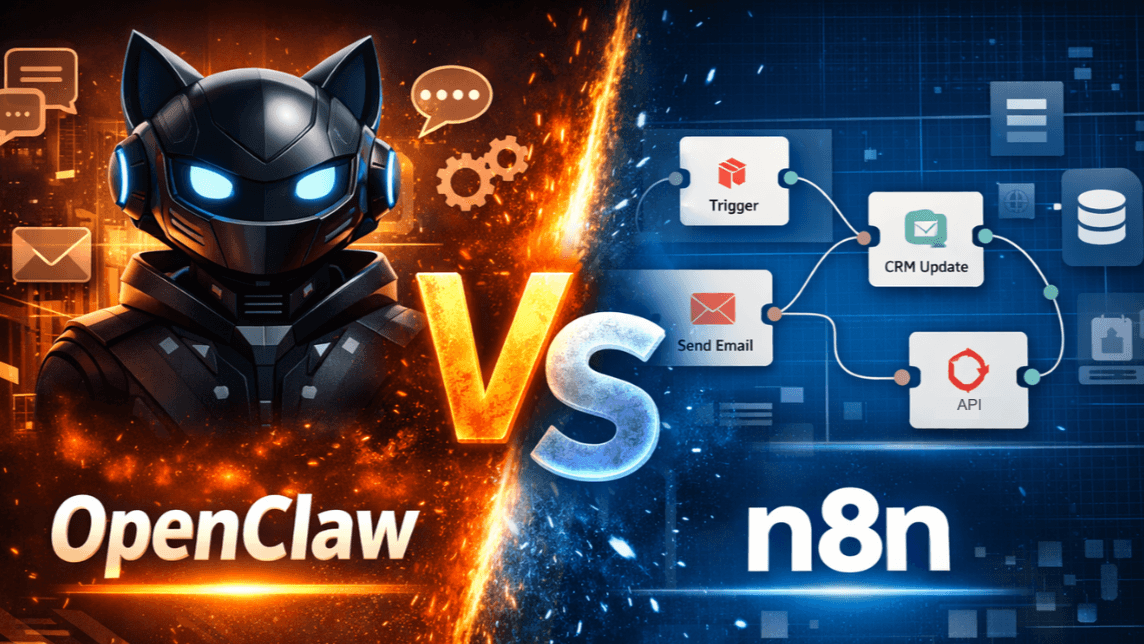
If you've been building automations lately, you've probably noticed something: "workflow automation" and "AI agents" are no longer the same category. OpenClaw and n8n sit on opposite ends of that spectrum — and that's exactly why people keep comparing them.
This article breaks down the difference in a way that's useful for builders, founders, and tech leaders — with facts, figures, and practical decision guidance.
1) What each tool actually is
OpenClaw: "Personal AI assistant" (agent-first)
OpenClaw positions itself as a personal AI assistant you run on your own devices, living inside the chat channels you already use (WhatsApp/Telegram/Slack/Discord/Teams, etc.). It's built for reasoning + conversation + tool use — i.e., an agent runtime that can talk, decide, and act.
Key implication: OpenClaw is optimized for "intent → reasoning → action."
n8n: "Workflow automation" (deterministic-first)
n8n is a node-based automation platform designed for connecting systems via integrations, triggers, and steps. It supports self-hosting and cloud, and highlights "400+ integrations" and extensibility.
Key implication: n8n is optimized for "event → defined workflow → predictable execution."
2) Facts & figures (community traction + project signals)
Here are measurable signals from the public repos (captured Feb 2026):
GitHub traction
- OpenClaw: ~225k stars, 43k forks, 824 contributors, 52 releases (latest shown Feb 24, 2026).
- n8n: ~176k stars, 55.2k forks, 614 contributors, 536 releases (latest shown Feb 23, 2026).
Interpretation (practical, not hype):
- OpenClaw's numbers signal massive viral adoption + fast-growing ecosystem.
- n8n's release volume strongly signals mature shipping cadence and operational stability.
3) Licensing & business reality (this matters for "enterprise")
OpenClaw: MIT (permissive)
OpenClaw is listed under the MIT license on GitHub. That typically means you can commercialize freely (subject to MIT terms).
n8n: Sustainable Use License (fair-code) + enterprise options
n8n is "fair-code" under the Sustainable Use License (SUL) plus an n8n Enterprise License. The docs describe SUL as allowing use/modify/redistribute with limitations, including restricting use primarily to internal business purposes, and disallowing paid hosting/white-labeling without a commercial agreement. n8n also explicitly states it does not call itself OSI open-source due to these limitations.
Why this matters:
- If your goal is "embed this as a commercial platform for customers", licensing becomes a board-level decision, not a dev preference.
- If your goal is internal automation, n8n's model is usually straightforward.
4) Product focus: agent experience vs workflow experience
OpenClaw shines when…
- You want a chat-native assistant that users interact with naturally (messages/voice), and it can call tools on your behalf.
- You want data to remain where you choose (laptop/homelab/VPS) rather than "all SaaS."
- Your automations are ambiguous and benefit from reasoning ("figure out what the user wants, then do it").
n8n shines when…
- You need predictable pipelines: webhooks, retries, branching, transformations, scheduled jobs, and audit-friendly execution trails.
- You want a huge library of integrations and templates — n8n highlights 400+ integrations.
- You are scaling ops where determinism beats creativity.
5) Pricing & operating model (a quick reality check)
n8n publishes plan pricing and shows it is based on monthly workflow executions, with tiers that include both hosted and self-hosted options (including an explicitly listed "Self-hosted" Business tier).
OpenClaw, in contrast, is typically run on your infrastructure with your model/provider keys (as per its positioning).
So the cost model often becomes:
- OpenClaw: infra + model usage (you manage it).
- n8n: infra (if self-hosted) + licensing/plan decisions + execution-based metering on cloud plans.
6) Security & governance: "agent risk" vs "workflow risk"
Workflows have classic risks (credentials, secrets, data movement). Agents add a newer category: prompt injection + tool misuse.
OpenClaw's own launch post explicitly flags that prompt injection remains an industry-wide unsolved problem and points to security best practices.
In Feb 2026, OpenClaw also appeared in multiple security-related news stories highlighting broader ecosystem concerns about open agent tooling and misuse scenarios.
My practical takeaway (for serious teams):
- If you deploy agents, treat them like production software with identity, policy, approvals, and audit logs — not like a weekend script.
- If you deploy workflows, standard DevSecOps discipline still applies — secrets management, least privilege, observability.
7) The decision framework (simple & useful)
Choose OpenClaw-first if:
- Your product is "assistant-led," chat-first, voice-first, and needs reasoning.
- You need flexibility in how tasks are interpreted and executed.
- You want permissive licensing (MIT) for broad commercialization.
Choose n8n-first if:
- You need deterministic automation with strong repeatability.
- Your org relies on integrations at scale (CRM, data sync, internal ops).
- You want a mature shipping cadence and conventional workflow patterns.
Choose both if:
- You want the best of both worlds: OpenClaw for "understanding + intent + conversation," and n8n for "execution engine + integrations + auditability."
This "agent + workflow" pairing is increasingly the real-world winning architecture.
Final thought
OpenClaw and n8n aren't truly substitutes. They represent two layers of the same modern automation stack:
- Agents decide what to do
- Workflows do it reliably
If you're building for enterprise trust (especially regulated domains), the next big moat won't be "more automation." It will be governed automation — identity, policy, approvals, and auditability.